
Marketing Without The Bullshit: The Marketing Advice UK SMEs Should Stop Listening To
Let's be honest.
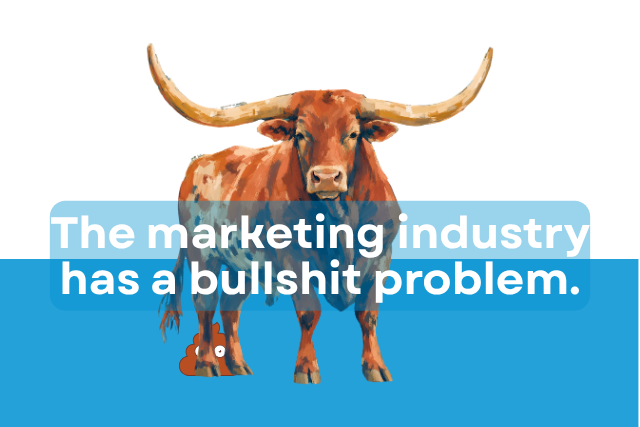
The marketing industry has become very good at making simple things sound complicated.
You've got SEO experts telling you that you need hundreds of pieces of content.
Social media experts telling you to post every day.
PPC agencies telling you about impressions, clicks and CTR.
Website companies telling you that your new website will transform the business.
And consultants talking about "brand ecosystems", "omnichannel customer journeys" and "content-led growth strategies".
It all sounds very impressive.
But there's a problem.
Most SME owners don't need more marketing jargon. They need more customers.
That's why I've got a slightly different view of marketing.
After more than 20 years working in marketing, I've learned that the best marketing is usually not the most complicated.
It's the stuff that works.
So, here are a few things I think UK SMEs should stop believing.
You Don't Need To Be On Every Social Media Platform
You don't.
If your customers aren't spending their time on TikTok, why are you?
If LinkedIn is where your buyers actually spend time, why are you obsessing over Instagram?
And if your business generates most of its enquiries through Google, perhaps spending three hours a day creating Facebook posts isn't the best use of your time.
There seems to be a strange belief that being everywhere means you're doing good marketing.
It doesn't.
It usually means you're spreading your time, money and attention too thinly.
You Don't Need To Post Every Day
This is one of my favourites.
"Post consistently."
"Post every day."
"Keep feeding the algorithm."
Fine.
But ask yourself a simple question.
What is the point?
If you're publishing seven posts a week that nobody reads, you've achieved consistency.
You haven't necessarily achieved marketing.
I'd rather see an SME publish one genuinely useful piece of content that attracts the right customer than seven posts saying:
"Happy Monday!"
"Here's our team."
"Did you know we're passionate about quality?"
"Five reasons to choose us."
You get the idea.
Likes Are Not A Business Strategy
I've never understood why businesses get so excited about social media engagement when it has no connection to revenue.
10,000 views sounds fantastic.
500 likes sounds fantastic.
2,000 followers sounds fantastic.
But if none of those people ever become customers, what have you actually achieved?
I'm not saying engagement doesn't matter.
It can.
But it needs context.
If you're a £2m engineering company selling £50,000 projects, I'd rather you had 200 followers and five serious enquiries than 20,000 followers and nothing in the sales pipeline.
Stop Chasing Traffic. Start Chasing The Right Traffic.
Here's another one.
"Your website needs more traffic."
Does it?
Maybe.
But more traffic isn't necessarily the answer.
Imagine you sell commercial roofing and your website gets 10,000 visitors a month.
Sounds good.
Except 9,500 of them are looking for DIY advice.
That's not marketing success.
It's traffic.
There's a difference.
I'd rather have 500 visitors who are actively looking for commercial roofing services than 50,000 people who have absolutely no intention of buying from you.
That's why keyword intent matters.
High-intent searches such as "commercial roofing contractor near me", "marketing consultant for small business UK" or "solar panel installation quotes" are potentially far more valuable than broad searches generating huge volumes of irrelevant traffic.
SEO Isn't About Stuffing Keywords Into A Blog
This one really needs to die.
You don't rank because you've mentioned your target keyword 47 times.
You rank because your content is relevant, useful, credible and provides a good answer to what someone is searching for.
Yes, keywords matter.
Of course they do.
But there's a big difference between sensible SEO and writing for a robot.
If you're writing a blog, start with the question your customer is actually asking.
Then answer it.
Properly.
Structure the content so it's easy to read.
Use relevant headings.
Include useful internal links.
Answer related questions.
Make it easy for Google and increasingly AI search platforms to understand what you're talking about.
That's SEO.
The rest is detail.
And Your Blog Doesn't Need To Be 2,000 Words
Another bit of advice that gets repeated endlessly.
"Every blog should be at least 2,000 words."
Why?
If you can answer the question properly in 700 words, why would you write another 1,300?
Padding.
That's what it becomes.
The reader doesn't care how many words you've written.
They care whether you've answered their question.
A 750-word article that actually solves a problem is better marketing than a 2,500-word article that takes five minutes to get to the point.
Your Website Probably Isn't The Problem
Sometimes it is.
But I've lost count of the number of businesses that think a new website is the answer to poor sales.
It usually isn't.
A new website won't fix a poor proposition.
It won't fix bad targeting.
It won't fix a lack of leads.
It won't fix terrible sales follow-up.
And it won't magically make customers want your product.
Before spending £10,000 on a new website, I'd want to know why the existing one isn't working.
What pages get traffic?
Where do visitors leave?
What are people searching for?
Which pages generate enquiries?
What happens after someone fills in the form?
Are you even tracking it properly?
If you aren't, you're guessing.
I've written about this before in getting maximum information from tagging actions for analytics.
Because there's very little point spending more money on marketing if you don't know what your existing marketing is actually doing.
A Marketing Strategy Isn't A 50-Page PDF
I've seen plenty of "marketing strategies".
They look fantastic.
SWOT analysis.
Competitor analysis.
Customer personas.
Market segmentation.
Brand positioning.
Content calendars.
Channel strategies.
KPIs.
Graphs everywhere.
Then someone puts the document in a drawer and carries on doing exactly what they were doing before.
That's not strategy.
A useful marketing strategy should tell you what you're going to do, why you're going to do it, who you're targeting, how you're going to measure it and, importantly, what you're not going to do.
I've written more about the strategic marketing planning process that actually works.
And yes, sometimes the answer is to do less.
More Leads Aren't Always The Answer
This might be controversial coming from a marketing agency.
But here goes.
You might not need more leads.
You might need better leads.
Or you might need to do a better job of converting the ones you've already got.
I've seen businesses spend thousands generating enquiries, only to have them sit unanswered for two days.
Then they blame marketing.
Your marketing can generate 100 enquiries.
If your sales process converts two of them, you've got a sales problem.
This is why I prefer to look at the whole journey:
Traffic → enquiry → qualified lead → sales conversation → proposal → sale → revenue.
Marketing doesn't exist in isolation.
Cheap Leads Can Be Very Expensive
Another classic.
"We can get you leads for £20 each."
Fantastic.
How many become customers?
"Well, we don't know."
Not so fantastic.
A £20 lead that never buys is worth nothing.
A £100 lead that turns into a £10,000 customer could be extremely valuable.
This is why cost per lead is only part of the picture.
You need to understand cost per qualified lead, cost per acquisition and ultimately customer value.
If you're trying to scale an SME, that's a much more useful conversation than simply asking how many leads an agency can deliver.
This is also why working with a small business marketing consultant in the UK can sometimes make more sense than simply buying another marketing service.
You need someone looking at the commercial picture, not just one channel.
AI Isn't A Marketing Strategy Either
We're seeing another wave of this now.
AI will transform marketing.
AI will replace SEO.
AI will replace agencies.
AI will write all your content.
AI will make your website irrelevant.
Take your pick.
Some of it will happen.
Some of it won't.
But the biggest mistake would be treating AI as a strategy rather than a tool.
If your marketing was rubbish before AI, putting AI into the process probably won't magically fix it.
It might just allow you to produce rubbish faster.
The businesses that benefit from AI will still need to understand their customers, positioning, differentiation, search behaviour and commercial objectives.
Technology changes.
Those fundamentals don't.
The Biggest Marketing Problem For SMEs? Doing Too Much
This is probably the biggest piece of marketing bullshit I see.
Businesses are told they need:
SEO.
PPC.
Facebook.
Instagram.
LinkedIn.
TikTok.
Email.
Blogs.
Video.
Podcasts.
Influencers.
PR.
Networking.
Webinars.
AI.
The list goes on.
So they try to do everything.
And inevitably, none of it gets done particularly well.
I'd much rather see an SME dominate one or two channels than be mediocre across ten.
Work out where your customers are.
Work out what they want.
Work out what makes them buy.
Then put your resources there.
Marketing Should Start With The Business, Not The Channel
This is where I think a lot of marketing goes wrong.
Someone decides:
"We need SEO."
Why?
"We need Google Ads."
Why?
"We need social media."
Why?
"We need a new website."
Why?
The channel becomes the starting point.
It shouldn't.
Start with the business objective.
Maybe you need 20 new customers a month.
Maybe you've got a sales pipeline problem.
Maybe your average customer value has fallen.
Maybe you're launching a new service.
Maybe you're expanding into a new region.
Maybe you're spending £5,000 a month on marketing and have no idea whether it's working.
Then decide what marketing activity is actually going to help.
That's strategy.
I've written about how to plan a marketing strategy that works if you want to dig deeper into that approach.
So What Does Marketing Without The Bullshit Actually Mean?
It doesn't mean ignoring SEO.
It doesn't mean abandoning social media.
It doesn't mean stopping advertising.
It doesn't mean every agency is ripping you off.
And it certainly doesn't mean there's some magic marketing tactic that nobody else has discovered.
It means being honest about what you're doing and why you're doing it.
It means asking whether something is actually producing a return.
It means being prepared to stop things that don't work.
It means understanding that 10,000 website visitors aren't necessarily better than 500.
It means knowing that a £20 lead isn't necessarily better than a £100 lead.
It means recognising that a marketing strategy doesn't need to be complicated.
And it means putting commercial results ahead of vanity metrics.
Here's My Uncomplicated Approach
I'd boil good SME marketing down to five questions:
1. Who are you trying to sell to?
Not "everyone".
Be specific.
2. What problem are you solving for them?
Not what you sell.
What problem do you solve?
3. Why should they choose you?
If the answer is "because we're great", try again.
4. Where are they looking for a solution?
That's where your marketing needs to show up.
5. What happens when they respond?
Because generating an enquiry is only the beginning.
Get those five things right and then we can start talking about SEO, Google Ads, social media, content, websites, AI and everything else.
In that order.
Not the other way around.
Marketing Doesn't Need More Bullshit. It Needs More Common Sense.
After 20+ years in marketing, I'm increasingly convinced that we're making this stuff far more complicated than it needs to be.
The technology is changing.
Search is changing.
AI is changing.
Consumer behaviour is changing.
But the fundamentals haven't changed nearly as much as some people would have you believe.
Find the right people.
Give them a good reason to choose you.
Make it easy for them to buy.
Get your message in front of them.
Measure what happens.
Then do more of what works.
And stop doing what doesn't.
That's not particularly sexy.
It probably won't make a great LinkedIn buzzword.
But it is marketing.
And IMHO, SMEs don't need more marketing bullshit. They need marketing that works.
About The Author
Rob Budd is the founder of Axcellerate Marketing, a professional marketing agency helping UK SMEs generate more enquiries, improve their marketing strategy and get a better return from their investment.
Rob has over 20 years' experience working in marketing at the highest level, across major brands, agencies and businesses. His approach is straightforward: cut through the jargon, focus on what matters and make marketing work harder for the business.
Read the latest Blog here https://www.axcellerate.co.uk/blog/your-marketing-isnt-boring-you-are/