
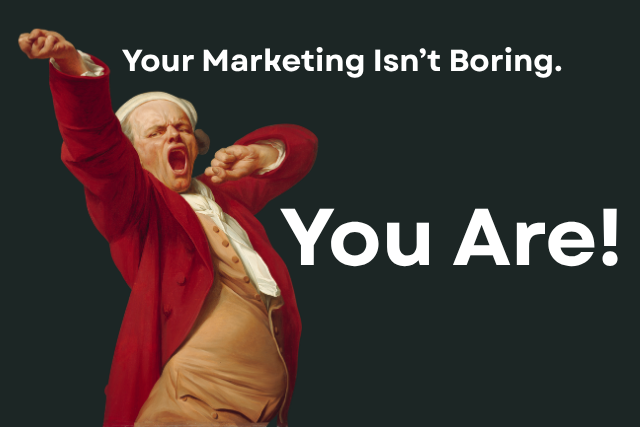
Your Marketing Isn’t Boring. You Are.
If your marketing feels boring, the problem probably isn't your industry.
It probably isn't your budget either.
And it definitely isn't because your customers "aren't on social media".
The uncomfortable truth is that your marketing might be boring because you are making it boring.
There. I said it.
Too many businesses write marketing designed to avoid upsetting anyone, saying anything interesting or, heaven forbid, having an opinion.
The result?
Safe headlines. Bland websites. Generic social posts. Stock photography. Corporate waffle. Endless posts about "our fantastic team" and "another five-star review".
Nothing technically wrong with any of it.
And almost nothing memorable about it.
Why Is So Much Business Marketing So Boring?
Because businesses tend to talk about themselves instead of talking about what their customers actually care about.
"We are a leading provider of..."
"We pride ourselves on..."
"Our experienced team..."
"We offer a comprehensive range of..."
Sound familiar?
These phrases aren't necessarily bad. They're just so overused that people have learned to ignore them.
Your potential customer doesn't wake up thinking about your company structure, your awards or how many years you've been trading.
They have a problem.
They want something.
They're worried about something.
They're trying to work something out.
Your marketing has one job at that point.
Make them stop scrolling.
Then make them care.
Then give them a reason to take the next step.
Boring Marketing Doesn't Mean Bad Marketing
This distinction matters.
A boring piece of marketing can still rank on Google.
It can still be technically optimised.
It can still have excellent crawlability, sensible headings, relevant keywords and a perfectly respectable meta description.
But SEO isn't simply about getting people onto a page.
It's about what happens when they arrive.
If the search result promises one thing and the page delivers another, they'll leave.
If the content feels generic, they'll leave.
If they can't immediately see why your business is relevant, they'll leave.
If your website looks like every other business in your sector, they'll probably keep looking.
Search engines care about relevance, usability and signals of user satisfaction. Humans are even less forgiving.
That's why good SEO and good copywriting have to work together.
The Real Problem: Marketing That Sounds Like Everyone Else
Take almost any competitive industry.
Roofers.
Accountants.
Recruiters.
Solicitors.
Estate agents.
Builders.
Marketing agencies.
Now search for ten companies.
You'll probably see the same words appearing again and again.
Professional.
Reliable.
Trusted.
Quality.
Experienced.
Friendly.
Bespoke.
Customer-focused.
There is nothing inherently wrong with these words.
The problem is that everybody uses them.
When everyone sounds the same, nobody stands out.
And when nobody stands out, price often becomes the easiest thing for a customer to compare.
That's not where you want to be.
Your Customers Don't Need More Marketing. They Need a Reason to Notice You.
This is where positioning comes in.
Good marketing isn't about shouting louder.
It's about having something worth listening to.
That might be an opinion.
A different way of doing something.
A strong point of view.
A useful observation.
A surprising statistic.
A story.
A mistake you've made.
A lesson you've learned.
A problem nobody else in your industry is talking about.
Or simply saying what everyone else is too frightened to say.
That's where interesting marketing starts.
Step 1: Stop Talking About What You Do
This is probably the easiest change you can make.
Instead of starting with:
"We provide professional SEO services to businesses across the UK."
Try starting with:
"Your website isn't invisible because Google hates you."
Now you've created curiosity.
Or:
"Most businesses don't have an SEO problem. They have a 'nobody knows we exist' problem."
That's a conversation.
The service can come later.
The first job of your content is to earn attention.
Step 2: Talk About the Problem Your Customer Actually Has
Your customers don't buy SEO.
They buy visibility.
They don't buy Google Ads.
They buy enquiries.
They don't buy marketing strategy.
They buy clarity.
They don't buy a new website.
They buy a website that makes it easier for people to choose them.
This is the difference between describing a service and selling an outcome.
The best marketing gets inside the customer's head.
What are they searching for?
What are they worried about?
What have they already tried?
What annoys them?
What are they secretly embarrassed about?
What question are they typing into Google at 11pm because they don't want to ask someone else?
Those questions are content gold.
They also reveal search intent.
And understanding search intent is one of the most important parts of modern SEO.
Step 3: Have an Opinion
This is where most business marketing falls apart.
Everyone wants to sound professional.
Nobody wants to sound controversial.
So everything becomes bland.
But having an opinion doesn't mean being offensive.
It means being prepared to say:
"We don't think that's a good idea."
Or:
"Most businesses are wasting money on this."
Or:
"You probably don't need that service."
Or:
"Here's what we'd do differently."
People can disagree with you.
That's fine.
In fact, disagreement can be useful.
Because disagreement creates conversation.
Conversation creates engagement.
And engagement creates attention.
Step 4: Stop Creating Content for Algorithms
Google doesn't buy from you.
LinkedIn doesn't buy from you.
Facebook doesn't buy from you.
People do.
Of course, technical SEO matters.
Your site needs to be crawlable.
Your pages need sensible structure.
Your content needs to satisfy search intent.
Your internal linking should make sense.
Your website needs to work properly on mobile.
Your page speed and user experience matter.
But technical optimisation is the foundation, not the personality.
Once the foundations are right, your content still needs to be worth reading.
Otherwise you're simply creating beautifully optimised content that nobody remembers.
Step 5: Make Your Website Sound Like a Human Being
Read your homepage out loud.
Actually read it.
If you wouldn't say it to a customer sitting across the table from you, rewrite it.
Remove unnecessary corporate language.
Remove filler.
Remove sentences that exist purely because somebody thinks websites are supposed to contain them.
Say what you do.
Say who you help.
Say what problem you solve.
Say why someone should care.
Then tell them what to do next.
Simple.
Step 6: Build a Marketing Point of View
This is where content strategy becomes much more powerful.
Instead of asking:
"What should we post this week?"
Ask:
"What do we want to become known for?"
That's a very different question.
For example, a marketing agency could become known for:
Marketing without the bullshit.
Calling out bad marketing advice.
Explaining SEO in plain English.
Helping SMEs stop wasting advertising budget.
Showing what happens behind the scenes.
Challenging common industry assumptions.
Sharing real marketing lessons rather than generic tips.
Now you have a territory.
And once you have a territory, content becomes easier.
You aren't desperately searching for something to post.
You're building an identifiable point of view.
A Simple Framework for More Interesting Marketing
Use this framework when creating your next campaign, blog post, social post or landing page.
1. Hook
Give people a reason to stop.
Ask a question.
Make a bold observation.
Challenge an assumption.
Say something unexpected.
2. Problem
Show that you understand what your customer is dealing with.
Be specific.
The more recognisable the problem, the more relevant your message becomes.
3. Insight
Give them something useful.
Explain why the problem exists.
Show them something they may not have considered.
4. Solution
Now introduce your approach.
Not as a hard sell.
As the logical next step.
5. Proof
Use evidence.
Examples.
Results.
Experience.
Customer feedback.
Case studies.
Demonstrations.
Anything that makes the claim more credible.
6. Action
Tell people what to do next.
Read something.
Book a call.
Request an audit.
Get a quote.
Ask a question.
Don't make them guess.
The SEO Connection: Interesting Content Still Needs Structure
Being interesting doesn't mean ignoring SEO.
Quite the opposite.
The strongest content combines personality with structure.
Your page should have a clear topic and search intent.
Your H1 should tell both users and search engines what the page is about.
Subheadings should make the content easy to scan.
Internal links should help visitors discover relevant information.
Images should support the content rather than simply decorate it.
The page should be technically accessible and crawlable.
And your content should answer the question better than the average result.
This is where SEO, copywriting and user experience come together.
You don't have to choose between writing for Google and writing for humans.
Write for humans first.
Then make it easy for Google to understand.
What About Dwell Time?
Dwell time is often discussed as though there is a magic number you need to hit.
There isn't.
But the underlying principle is useful.
If someone lands on your page and immediately thinks, "This isn't for me", you've lost them.
If they find the answer they wanted, discover something useful and continue reading, you've created a better user experience.
That's what you should be aiming for.
Not tricks.
Not keyword stuffing.
Not writing 3,000 words because somebody told you Google likes long content.
Useful content wins attention.
Useful content earns trust.
And useful content gives people a reason to take the next step.
Your Marketing Should Sound Like Your Business
This is the bit many businesses miss.
Your marketing shouldn't sound like "marketing".
It should sound like you.
If you're funny, be funny.
If you're direct, be direct.
If you're technical, explain things clearly.
If you have strong opinions, use them.
If you've made mistakes, talk about them.
If you've spent 20 years learning what doesn't work, don't hide that experience behind corporate language.
Personality isn't a luxury.
It's differentiation.
And in crowded markets, differentiation matters.
Don't Confuse Professional With Bland
This deserves its own section because it's one of the biggest problems in B2B marketing.
Professional does not mean boring.
Professional means credible.
It means knowing what you're talking about.
It means delivering what you promise.
It means understanding your customer's business.
It doesn't mean writing every sentence as though it has been approved by a committee of lawyers.
Some of the most effective B2B marketing is funny, blunt, opinionated and occasionally provocative.
Why?
Because business buyers are still human beings.
They scroll LinkedIn.
They search Google.
They get bored.
They laugh.
They get annoyed.
They have problems.
And they remember businesses that make them think.
The Bigger Marketing Problem
Sometimes the problem isn't your content.
It's that your marketing has no direction.
You might have a website.
An SEO agency.
A PPC campaign.
A social media account.
A CRM.
An email platform.
A freelancer.
A designer.
A sales team.
And still have absolutely no idea what's actually driving growth.
That's when you need to step back and look at the whole picture.
A good marketing strategy should connect positioning, audience, channels, content, search, paid advertising, conversion and measurement.
If those pieces are operating independently, you're not necessarily running a marketing strategy.
You're running a collection of marketing activities.
There is a difference.
If you need senior strategic input without immediately hiring a full-time Marketing Director, take a look at Axcellerate's marketing consultant and fractional Marketing Director service.
Marketing Should Help You Scale, Not Just Keep You Busy
Growth creates another problem.
What worked when you had five customers may not work when you have fifty.
What worked when you were doing everything yourself may not work when you've got a team.
And what worked when you were known locally may not work when you're trying to expand.
That's why marketing strategy needs to evolve alongside the business.
The question isn't simply:
"How do we get more leads?"
It is:
"What kind of growth are we trying to create, and what marketing system will support it?"
I've written more about this in Scaling with Purpose.
Because growth without a plan can simply mean becoming busier, more expensive and more complicated.
That's not necessarily progress.
And Sometimes the Best Marketing Advice Is Don't Hire Us
Seriously.
If your marketing is working brilliantly, your lead flow is healthy, your advertising is profitable, your positioning is clear and you're getting exactly the results you want, you probably don't need another marketing agency.
That's why we wrote 5 Reasons NOT to Use Axcellerate Marketing for Your UK Business.
It's deliberately not the usual agency sales pitch.
Because good marketing isn't about convincing everyone to buy.
It's about finding the people who have a problem you can genuinely solve.
So, Is Your Marketing Actually Boring?
Maybe.
But before you blame your industry, your audience or the algorithm, look at the message.
Does it sound like everyone else?
Does it talk more about you than your customer?
Does it have a point of view?
Does it make anyone curious?
Does it answer a real question?
Does it give people a reason to remember you?
Does it make the next step obvious?
If the answer to most of those questions is no, you've probably found the problem.
Your marketing doesn't need to become louder.
It needs to become more interesting.
More specific.
More human.
More useful.
More confident.
And perhaps just a little less frightened of saying what you actually think.
Because boring marketing doesn't get ignored because people hate your business.
It gets ignored because there is nothing there worth stopping for.
Fix that.
Quick FAQ
How can I make my marketing more interesting?
Start by understanding what your customers actually care about. Talk about their problems, answer genuine questions, challenge assumptions and develop a recognisable point of view instead of producing generic promotional content.
Why does my marketing get no engagement?
There are many possible reasons, but generic messaging is a common one. If your content could have been written by any competitor in your industry, there may be little reason for someone to stop, read or respond.
Does being controversial help marketing?
It can create attention, but controversy shouldn't be the objective. A strong, relevant opinion is usually more useful than deliberately trying to provoke people.
Should SEO content be entertaining?
It should be useful and engaging enough to satisfy the person who searched for it. Good SEO content combines search intent, relevant keywords, clear structure, internal linking, crawlability and a strong user experience with genuinely useful information.
How important is user experience for SEO?
Very. A technically sound website still needs to give visitors a clear, useful and relevant experience. If people cannot find what they need or understand what you offer, rankings alone won't turn traffic into customers.
How often should a business publish content?
There is no magic publishing frequency. Consistently producing genuinely useful content is generally more valuable than publishing several mediocre pieces every week simply to fill a content calendar.
Do small businesses need a marketing strategy?
Yes, particularly when marketing activity starts becoming fragmented. A clear strategy helps prioritise channels, audiences, messaging, budgets and measurement so the business knows what it is trying to achieve and why.
Can a marketing consultant help if we already have an agency?
Yes. A marketing consultant can provide senior strategic direction, review existing activity, identify gaps, manage agencies and help connect marketing activity to commercial objectives. The role doesn't necessarily replace existing suppliers.
Final Thought
Your customers aren't sitting around waiting for another company to tell them that it is "passionate about delivering exceptional solutions".
They're busy.
They're searching.
They're comparing.
They're scrolling.
They're trying to solve a problem.
Give them something worth stopping for.
Say something useful.
Say something different.
And for God's sake, sound like a human being.
Author: Rob Budd
Rob Budd is the founder of Axcellerate Marketing, a UK marketing agency helping SMEs turn marketing activity into measurable commercial results.